
A month of limping and uneven shoulders at eight years old cost me six years of physical therapy, four years of bracing, and seven years of a writhing twist in me that all the bracing and therapy never reached.
Seven years ago, my mom suspected that there was something bigger behind my bad posture and took eight-year-old me to the doctor. An X-ray of my spine was taken.
“You are diagnosed with scoliosis.” The doctor said—little me tiptoed earnestly and elongated my neck to see the X-ray on his computer.
A single colorless photo and five words from a strange, expressionless man—that was all that was needed to change the life of a girl who thought doctors were there to cure any bruise and give me a lollipop right after, and mothers were there to kiss bruises and make them vanish by morning.
I didn’t know back then. Little me nodded ambitiously as if assigned another piece of homework—done before 9pm, handed in the next morning—temporary, tangible.
That was all I remembered from that day and all I wished to remember.
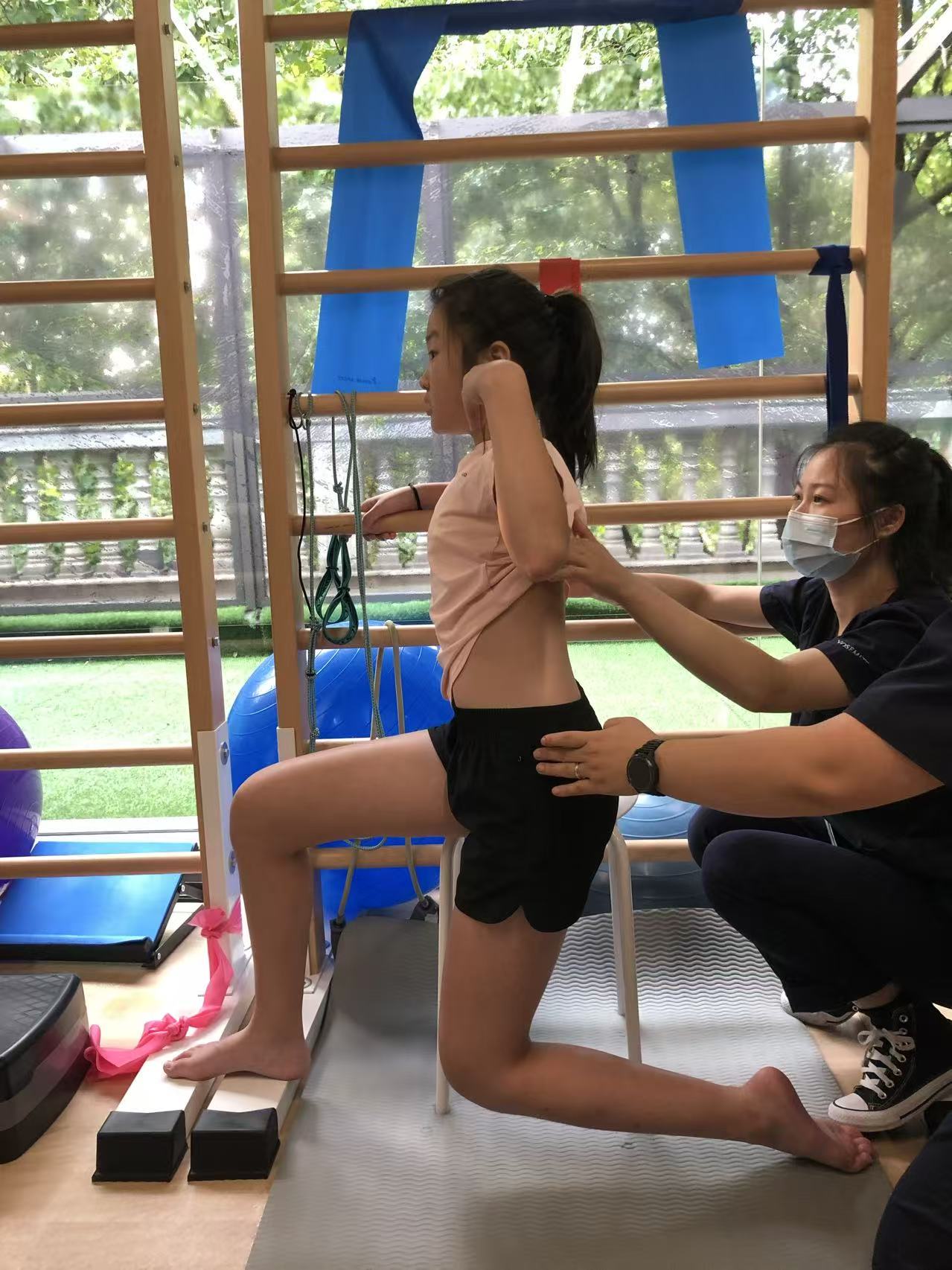
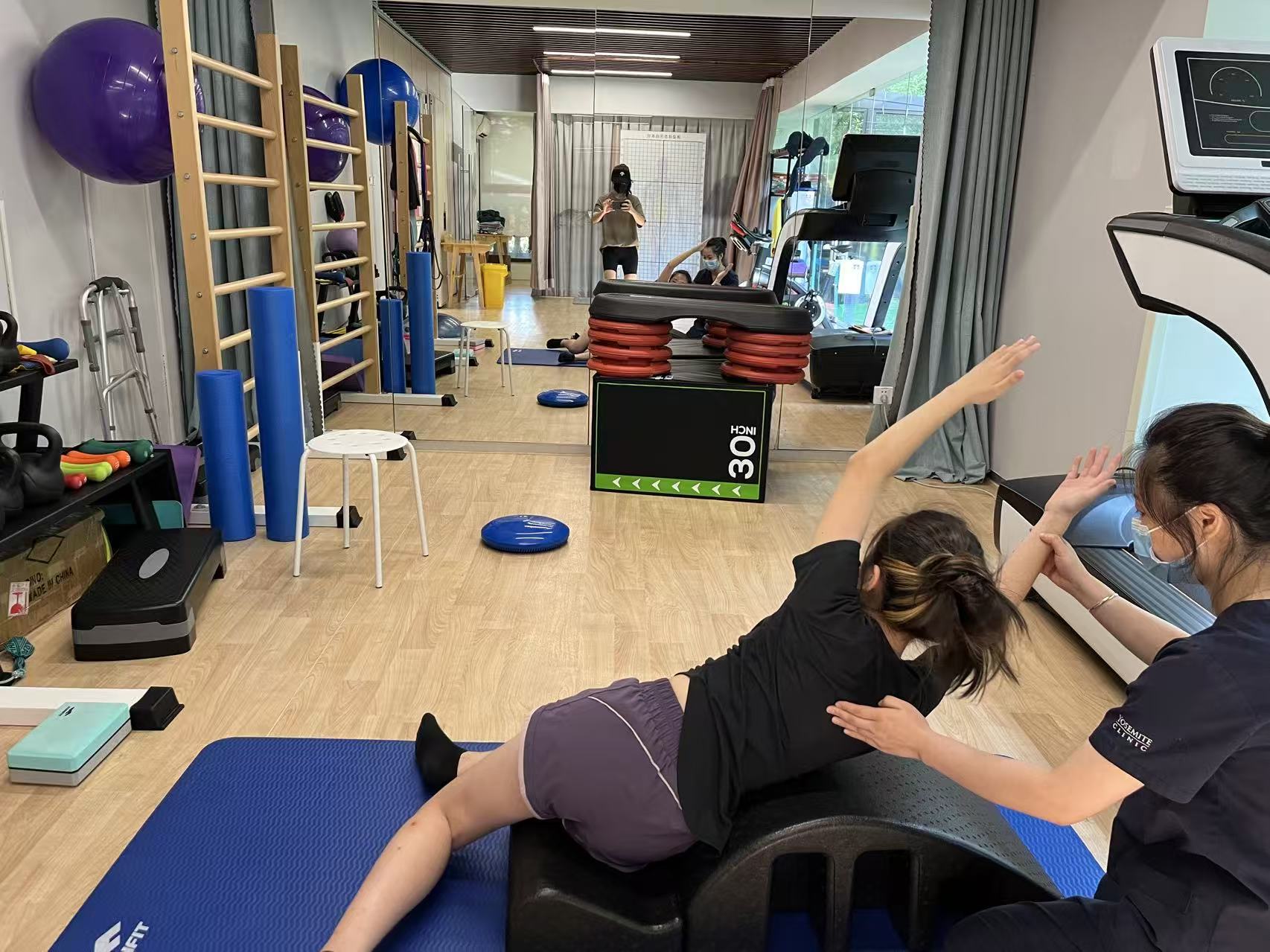
Soon, my weekly physical therapy sessions began in a bougie street in Shanghai. The bright-colored yoga balls, the toy-like equipment I got to assemble into a parkour, and the massages I get at the end of each session in my first studio excited me. What was less exciting was having to do the Schroth exercises every everyday. They were organized as pictures on a stubborn little poster defying all eroding waves of time.
During every session, I put on Sit Still, Look Pretty to make the process more fun or, unconsciously, to feel in control.
My mom placed her hands on the muscles I must activate and guided me set after set, repeating like a mantra, “1, 2, 3—breathe in to the right ribcage, hold, engage the rib and oblique muscles, elongate, breathe out—1, 2, 3.”
When she sometimes got mad at me for not getting a move right, I corrected myself at once; nothing ran through my mind but a child’s instinctual desire to please the woman she thought was always, and would only ever be, right.
But as I grew older, scoliosis became a little more complicated than physical therapy every Friday, blasting Sit Still, Look Pretty during my daily exercises, and correcting my posture obediently after my mom told me to.
The dull repetitions of scoliosis exercises every night at around eight made me throw tantrums at my mom and hate her at times. When she got impatient, even with something as slightly as a harder compression on my right rib, I would roll my eyes and snap, “I get it!”
Sometimes, she pushed through my attitude and continued guiding me through the exercises, just slightly annoyed; most of the times, she yelled at me and told me to pull myself together and face the fact that life is unfair. One time, she just stared.
One night near my bedtime, I was still doing scoliosis exercises on a worn-out yoga mat under dim lights. I wanted to sleep. Frustrated, I screamed, “I’ve had enough! I hate scoliosis!”
My mom ignored me and continued, rather shakily, “1, 2, 3—breathe in to the right ribcage, hold, en—”
She shuffled away from me and kneeled, sagging into the ground, almost shrinking in size. The muscle around her eyes shuddered as she stared at me until tears writhed down her cheeks.
“Fanpeiyi.” She croaked my full Chinese name and shook her head.
“Mama. Mama, I’m sorry.” Why is she crying?
She broke, “Every night I kneel beside you until my back hurts. I studied Schroth exercises, studied your X-rays, and begged doctors when your curve worsened—because I hate your scoliosis as much as you do. But I don’t look away. I do everything I can to hold you together.”
I should have cried too or hugged her, but I just stood there.
The truth was, I saw everything she did for me but didn’t process it, for I was too busy building a fortress of my own brooding until the walls were so high that I could not see what was outside. What about Mom?
A warm cream foamed in my body—numbness or sleepiness, it’s hard to tell.
Beside me, Mom yawned in her pajamas, waiting to go to sleep too.
She went to her bedroom, and I went to mine, changed into a scoliosis camisole, pushed my scoliosis brace onto my waist, and pulled the straps tight.
While some go to bed in their soft and cozy pajamas, I go to bed feeling my organs deform and grind each other, and the plastic walls of the brace gouge into my ribs.
I fell asleep anyway in the artificial exoskeleton; my body warmed up enough to trick me into believing it was some comforting blanket.
Just like any other exoskeleton, it will shed off one day, as the doctor promised—a day that never came.
I had been wearing braces since 2021, when my growth spurt began. Despite my mild curve, Doctor Gong advised me to wear a brace to manage the risks of the curve worsening during puberty. Thanks to her, my degree of curvature was a stable oscillation between 10 and 15 degrees in the past four years.
But doctors are not all-knowing. Doctor Gong promised that I’d be free from bracing at 13, but my curve worsened, and the brace remained. Every day, I performed my exercises and put on my brace—did them like stuttering, with the constant, gnawing repetitions and the wait for the right words, for the day I turn 14 and am freed from bracing.
Yet at 14, my curve worsened slightly again. Still, I stuttered.
What about when I turn 15? Yet my curve degree became an all-time worst. Still, I stuttered.
My parents often tell me, “When you’re a kid, life is defined by how hard you work. As you get older, life is defined by your choices. As you get even older, life is often defined by fate.” I always knew what it meant, but my scoliosis forced me to understand—
At 8, I corrected my posture and repeated my exercises day after day without missing a single session. At 11, I made the right choice of wearing a brace. But after 13, my spine sort of took a life of its own, rebelling and curving against my plea.
Scoliosis forced me to grow up fast—taught me, or rather, forced me to be resilient, responsible, and consistent and work hard while accepting things out of my control—all the good stuff I can put on resumes and give grand speeches about.
But my story is not some inspirational rise from the ashes. I am just another conflicting and chaotic human battling with the curves of life.
Whenever my mom reminded me to correct my posture or focus on my Schroth exercises, I grunted and snapped back every time, blind to all she did for me. I viewed her as a scapegoat. I was also not consistent with my Schroth exercises, sometimes stopping for months, and one time even for half a year. When I did do my exercises, I complained and often didn’t perform my exercises to the highest quality. Ignorant of the many privileges I enjoy, I regularly break down into angry sobs when reminded how unfair it is to have scoliosis; I cried especially hard when my curve worsened to the point that my mom forbade me to work out—my only way of being in control of my body.
I refuse to define my fight with scoliosis as a single, rehearsed serenade of resilience, responsibility, or perseverance. My healing is messy—some may not even call it healing. It came in as anger, fatigue, sadness, and frustration—the fractured chords that eventually tuned themselves into a pulsing piece of jazz.
I still complain and cry, but simultaneously, I sense the absurdity in doing so. My curve is stubborn, yes, but it is mild. Manageable. Livable.
It did not distort my body so much that I have to constantly check the mirror or be too scared to do so.
I did not experience scoliosis-related pain or trouble breathing.
My body was not locked in a brace 20 hours a day like many others.
My curve could be stabilized by exercise, not a chain of metal nails hammered into my spine.
My family’s financial comfort meant scoliosis never became a question of money.
To have a mother who fought for me and with me gave me a sense of safety I didn’t appreciate enough.
I grieved about the things scoliosis took from me, but I had never taken a breath to acknowledge what it didn’t take.
Little by little, between my occasional breakdowns, flowed an instinct to take care of myself. Putting on a brace, doing the exercises, and going to doctor appointments felt less like an imprisonment to my twisted fate and more like natural, mundane habits of care—no different from brushing my teeth or drinking water.
But the anger didn’t disappear; it simply stopped being the only thing I felt. I could be grateful and still furious. I could take care of myself but still resent the reason I had to. I could love my mom and still snap at her. I could do every exercise perfectly one day and ignore them the next.
My healing is not linear—it curves, just like my spine, just like rivers, rainbows, the spiral of a shell, and the branch of a sycamore—things that grow despite resistance.
Scoliosis is not curable. It cannot be forced straight, like many unfixable, uncontrollable things life slams us with. Some things must not be conquered but lived with, in their twists, arcs, and loops.
So I loosen my grip and stop demanding a straight line from a curved world.
I let it curve.
Currently, I continue bracing and doing Schroth exercises. However, I do them less regularly as my height and curve stabilize.

Read more patient stories like this from around the world.


